
Irish Sheep Meat Sector Insights: Trends Shaping the Market
Welcome to the fifth edition of the SUBU Connect Market Insight Series.
In this edition, we provide an overview of the Irish Sheep Meat (Lamb) sector, highlighting recent market developments, pricing trends, supply chain dynamics, and factors influencing availability. We also explore emerging risks and opportunities that may impact buyers and suppliers over the coming months.
Our objective is to provide a concise, evidence-based snapshot of current market conditions, helping industry stakeholders anticipate change, identify opportunities, and make more informed commercial decisions in an evolving marketplace.
1. MARKET SNAPSHOT
2. MARKET OVERVIEW
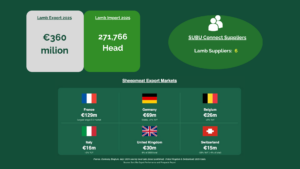
In 2025, Ireland’s Sheepmeat (Lamb) sector remained an important export industry, with sheep meat exports valued at approximately €360 million. Beef continues to be Ireland’s largest meat export category, with sheep meat representing a smaller but globally significant share, Ireland ranks as the 4th largest net exporter of sheep meat in the world and 2nd largest within the EU.
The European Union remains Ireland’s primary export region for sheep meat, with key markets including France, Germany, Belgium, Italy and the Nordics, which together accounted for 86% of export value in 2025 (around €310 million). While international markets such as the United States and the Middle East continue to present emerging opportunities, trade in 2025 remained heavily concentrated within the EU due to competitive pricing pressures from Southern Hemisphere suppliers and global supply constraints.
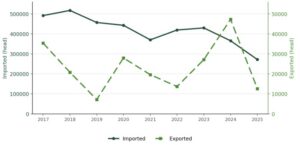
On the import side, Ireland continued to rely on significant volumes of live sheep imports in 2025, reflecting the sector’s structural dependence on inward live animal movements, predominantly from Northern Ireland. Live sheep imports have substantially exceeded exports every year since at least 2017, underlining Ireland’s position as a net importer of live sheep even as it remains a major net exporter of processed sheep meat. In 2025, live sheep imports total 271,766 head, down 26% on 2024, while exports total just 12,602 head, down 73% on 2024.
Domestic consumption of sheep meat in Ireland remained a modest share of overall meat consumption in 2024, accounting for just 5% of total meat supply (67,000 tonnes), with self-sufficiency at 385%, still vastly self-sufficient, though the only meat category where the self-sufficiency rate declined in the latest published CSO data.
Figure 1. Live Sheep Movements, 2017–2025 (head)
3. PRICE OVERVIEW
In 2025, Ireland’s sheep meat exports fell for the third year in a row to an estimated €360 million, with volumes down 15% to 51,000 tonnes.
3.1 Lamb
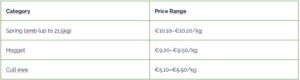
Irish lamb prices fell to €7.44/kg by the end of 2025, well behind Great Britain and France, but have since recovered strongly through 2026, reaching €9.23/kg by early June and pushing past €10/kg for top-quality lambs
3.2 Hogget
Hogget supply is falling faster than lamb numbers can make up for, with prices holding around €9/kg plus a quality bonus.
3.3 Ewe / Ram
Ewe and ram prices ranged €5–€5.30/kg, with throughput remaining stable.
Figure 2. June 2026 Price Range
Ireland’s sheep sector is supported by 33,805registered flock holdings nationally (Department of Agriculture, Food and the Marine, December 2024), with sheep meat processing forming part of a wider meat industry that employs around 16,000 people directly across all species.
4. RECOMMENDATIONS AND FUTURE TENDENCIES
Key opportunities and predictions for Ireland’s lamb and sheep meat sector include:
- US Market Expansion – Ireland gained access to sell lamb in the US in October 2025, and demand there is expected to grow to over 17,000 tonnes a year by 2029.
- EU/UK Supply Gap – other European countries are producing less lamb, which is good news for Irish exporters, but New Zealand and Australia are also stepping in to fill that gap.
- Sustainability – 7% of Irish sheep farms are now organic, and farms that go green could have an edge as buyers increasingly look for sustainable products.
- Digital Transformation – platforms like SUBU Connect make it easier to connect buyers and suppliers, helping the supply chain run more smoothly and opening up new business opportunities.
5. RISKS AND CHALLENGES
- Fewer sheep being bred and processed in Ireland, leading to less lamb available to sell
- Stronger competition from the UK, New Zealand and Australia.
- Fewer people in Europe eating lamb, especially among younger consumers
- Rising costs for farmers (feed, energy, labour) and stricter environmental rules
Should you be interested to find out more? Connect with us HERE
References:
Bord Bia (2025-2026) – Export Performance and Prospects Report Bord Bia
Beef & Sheep Update –IFA IFA
Agriland – Sheep Trade: Powerful prices remain available in post-Easter trade Agriland
The Farmer’s Journal – Irish Meat 2025 The Farmer’s Journal
Central Statistics Office – Livestock Survey & Meat Supply Balance 2024 CSO


