Welcome to the sixth edition of the SUBU Connect Market Insight Series.
In this edition, we provide an overview of the Irish Prepared Consumer Foods and ready-to-eat product market, highlighting market performance, pricing dynamics, and the opportunities available for producers, processors, and distributors looking to grow.
Our objective is to provide a concise, evidence-based snapshot of current market conditions to identify opportunities and to allow for our readers to make more informed commercial decisions in an evolving marketplace.
1. MARKET SNAPSHOT
2. MARKET OVERVIEW
A ready-to-eat product is any food that requires no further cooking or preparation before consumption. It is not a food category, it is a characteristic that cuts across almost every segment of the Prepared Consumer Foods (PCF) sector, from a chocolate bar to a pre-packaged meal to a tin of seasoned pulses. As lifestyles become busier and expectations around convenience higher, demand for products that are ready to consume is only increasing.
Ireland is well positioned to meet that demand. With a long-standing reputation for food quality, traceability, and sustainable production, Irish producers bring provenance that buyers trust and consumers respond to.
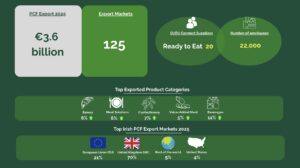
In 2025, Ireland’s PCF sector grew exports by 9% to €3.6 billion across 125 markets, employing over 22,000 people across 500 manufacturing facilities, contributing €1.1 billion in annual wages and €750 million in local economic activity. From large-scale processors in the midlands to specialist producers along the west coast, PCF manufacturing is spread equally across the country. The new national strategy targets €5.4 billion in PCF exports by 2035 and aims to grow sector employment to 38,000, a 25% increase from current levels.
What makes the sector particularly compelling is its import profile. Ireland is a net importer of prepared consumer foods, with the domestic industry accounting for just 46% of domestic consumption. Demand significantly exceeds domestic supply, and for Irish producers, that gap represents opportunity.
Export concentration remains high. The UK accounts for 70% (€2.2 billion, +10% YOY), the EU for 21% (€775 million), and the US for 4% (€120 million), but at +19% YOY, it is the market to observe.
Figure 1. Export Share by Value; Irish Prepared Consumer Foods 2025 (Bord Bia Report 2025-2026)
3. THE PCF SECTORS
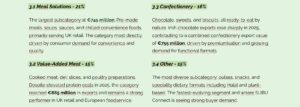
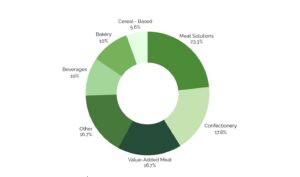
Ireland’s PCF categories continue to grow, and buyers are actively seeking suppliers who can deliver quality, agility and innovation across meal solutions, value‑added meat and confectionery. SUBU Connect strengthens this momentum by matching suppliers with the right buyers, reducing outreach time, effort and costs while streamlining tender participation.
4. RECOMMENDATIONS AND FUTURE TENDENCIES
Key opportunities and predictions for Ireland’s prepared food industry include:

- Watch the US market closely
A 19% year-on-year growth rate in PCF exports signals genuine opportunity for businesses willing to invest early in that market.
- Health, convenience, and transparency are here to stay
Consumer demand in these areas is a structural shift, not a trend. Products combining clean ingredient lists, nutritional clarity, and responsible packaging are increasingly preferred by consumers and buyers.
- Speciality dietary formats
Plant-based, high-protein, Halal, allergen-free, and pulse-based products represent the strongest direction of buyer demand.
- The 2035 target is ambitious but achievable
Ibec has set a target of 50% PCF export growth by 2035, backed by policy support and institutional investment.
5. RISKS AND CHALLENGES
- Compliance and labelling requirements are strict and differ across Ireland, the UK, and the EU
- With no kill step at the point of consumption, Listeria risk must be controlled entirely within production and distribution
- Short shelf life demands tight logistics, accurate forecasting, and strong retail relationships
- Input cost volatility across protein, energy, and sugar remains difficult to predict
- Private label competition and growing regulatory scrutiny of ultra-processed foods raise the bar for new entrants
6. SUBU Connect’s View
The scale of activity we are seeing across the SUBU Connect platform reflects the opportunity outlined in this report. A high volume of tenders, sourcing requests, and buyer enquiries are moving through the platform across meal solutions, value-added meat, and speciality grains and pulses, confirming that buyer demand is growing and not just a projection on paper. At the same time, the challenges set out in Section 5, tight margins, short shelf life, input cost volatility, and rising compliance complexity are shaping which suppliers can convert interest into won business.
One area we believe deserves closer scrutiny is the sustainability profile of imported ready-to-eat pulses and grains versus home-produced alternatives. As buyers face increasing pressure on carbon footprint and provenance credentials, the transport and storage emissions associated with imported product may sit uneasily alongside the “clean label” and traceability expectations driving demand elsewhere in the sector. This is a trade-off Irish producers are well placed to compete on, provided the commercial case is made clearly.
Should you be interested to find out more? Connect with us HERE
References:
Bord Bia (2026) Export Performance and Prospects Report 2025–2026. Dublin: Bord Bia. Available at: Bord Bia
Bord Bia (2025) Prepared Consumer Foods Sector Profile. Dublin: Bord Bia. Available at: Bord Bia
Ibec / Food Drink Ireland (2025) Prepared Consumer Foods Strategy for Ireland 2025–2035. Dublin: Ibec
The Farmer’s Journal (2025) ‘Adding Value to Added Value.’ The Farmer’s Journal, November. Available at: farmersjournal.ie